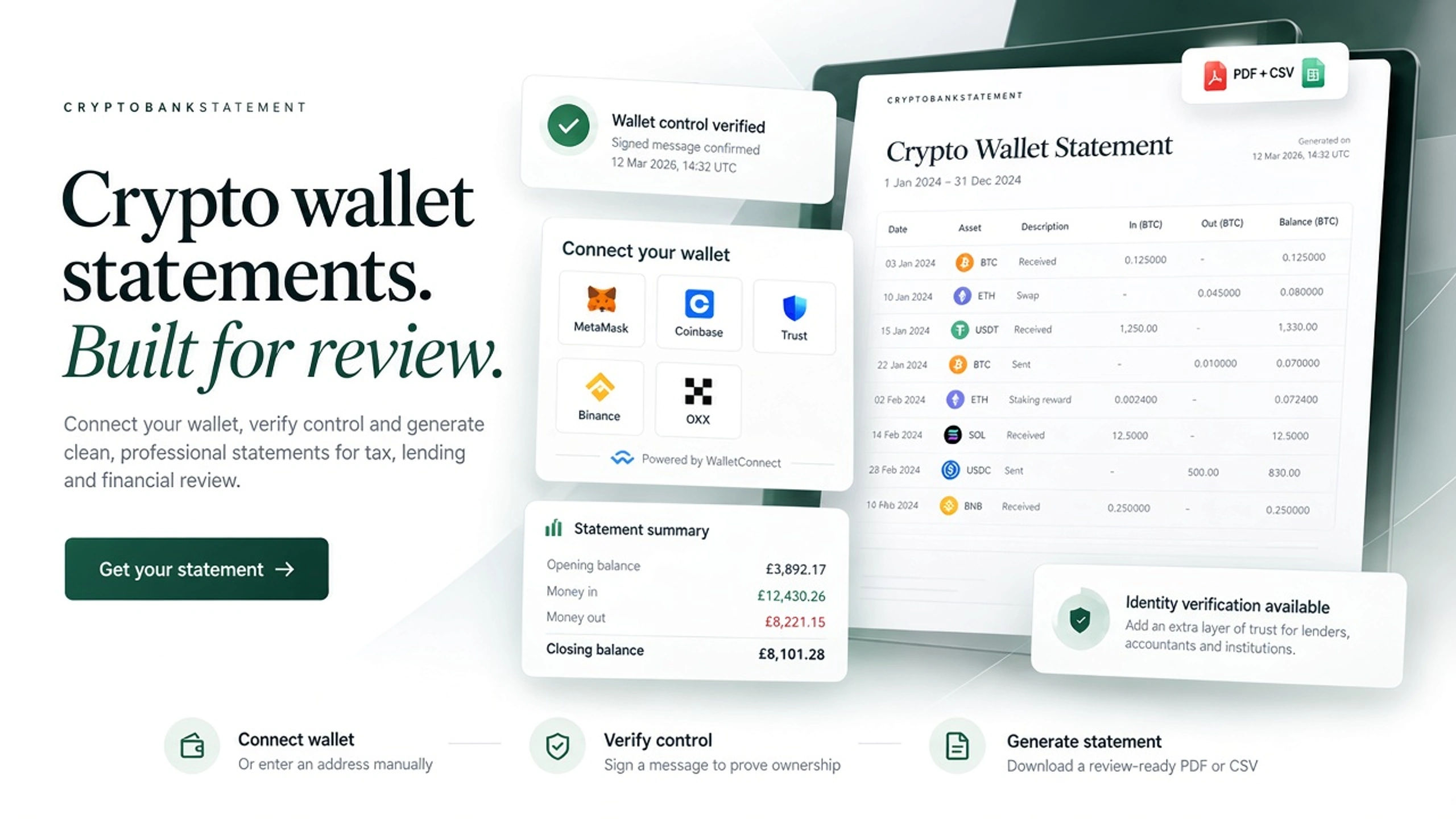





Crypto wallet statements. Built for review.

CryptoBankStatement reconstructs blockchain wallet activity, reconciles balances and applies historical fiat values to create financial statements for accounting, lending, source-of-funds and financial review.

Get your statementExplore the statement

Connect with wallets you already use

Connect compatible Ethereum wallets through WalletConnect. No private keys, recovery phrases or cryptocurrency transfers required.

  • MetaMask
    MetaMask
  • Coinbase Wallet
    Coinbase Wallet
  • Trust Wallet
    Trust Wallet
  • Binance Wallet, the self-custody wallet, not the Binance exchange
    Binance Wallet
  • OKX Wallet
    OKX Wallet

Ethereum mainnet only. MetaMask has been signature-tested here; Coinbase Wallet, Trust Wallet, Binance Wallet and OKX Wallet have not each been signature-tested. Binance Wallet is the self-custody wallet, not a Binance exchange account. This Ethereum connection does not include BNB Chain or Solana. Official Circle USDC on Base is a separate statement. Connecting does not verify control, and WalletConnect does not verify identity or endorse these statements.

Supported blockchains & assets

Generate reconciled crypto wallet statements from supported blockchains, with transaction history, historical fiat values and independently checkable on-chain evidence.

  • Bitcoin

    • BTC
  • Ethereum

    • ETH
    • USDC
    • USDT
  • Base

    • USDCOfficial Circle USDC

FROM BLOCKCHAIN TO BALANCE SHEET

A familiar format.
A traceable record.

Turn public wallet activity into a structured bank-style statement, with the detail a financial reviewer needs to follow the money.

01 The complete picture
Opening and closing balances, money in, money out and applicable network fees.
02 Values in context
Historical fiat estimates in GBP, USD, EUR, AED or INR, alongside native-asset amounts.
03 Evidence attached
Transaction references, reconciliation status and statement integrity metadata.
View the sample statement
EXPLORE YOUR STATEMENTSample data
CryptoBankStatementVerifiable records from public blockchain dataBTC

Wallet activity statement

01–30 April 2025 · Bitcoin

Opening balance1.2500 BTC
Closing balance1.6498 BTC

Money in +0.5000 Money out −0.1000 Fees 0.0002 BTC

Illustrative Bitcoin activity, not a real wallet
DateActivityAmount · BTC
04 AprReceived+0.5000
12 AprSent−0.1000
12 AprNetwork fee−0.0002
Evidence travels with your statement

Verification ID · Document checksum · Evidence appendix

A STRAIGHTFORWARD PROCESS

Your wallet. Your period. Your statement.

Get started
ILLUSTRATIVE WALKTHROUGH01 / 03

Start with the address you want to document

NETWORK / ASSETBitcoin BTC
PUBLIC WALLET ADDRESSbc1q…example…7k2p

Example address · connection optional for On-Chain

On-Chain statements need only a public address. Connecting a wallet does not move funds or verify control.

WHAT THE PRODUCT IS

A reconciled wallet statement, not a tax return.

CryptoBankStatement turns supported self-custody blockchain wallet activity into a dated, reconciled financial statement for financial review.

REPORTING WINDOW

Statements are available for activity within the most recent 36 months, up to the latest completed UTC day.

Statement end is normally the latest completed UTC day.

01 / PURPOSE

Is CryptoBankStatement crypto tax software?

No. CryptoBankStatement is designed for financial documentation rather than crypto tax calculation. Tax software is built to calculate gains, losses, disposals and filing figures. CryptoBankStatement reconstructs supported self-custody wallet activity into a reconciled statement.

02 / DOCUMENT TYPE

Does CryptoBankStatement issue a bank statement?

CryptoBankStatement is not a bank and does not issue regulated bank statements. It generates statement-style financial records from supported public blockchain wallet data.

SUBSTANCE BEHIND THE STATEMENT

Confidence starts
with the evidence.

Exact on-chain amounts. Documented valuations. A record that can be followed back to its source.

Read our methodology
A BALANCE YOU CAN FOLLOWIllustrative Bitcoin activity · BTC
Opening1.2500

The balance at the beginning of the reporting period.

Money in+0.5000

Incoming activity during the selected period.

Money out−0.1000

Outgoing activity, with applicable fees shown separately.

Fees−0.0002

Applicable network fees recorded independently.

Closing1.6498

The resulting ledger balance is checked against the independently established blockchain balance.

Select a balance component to learn more. This simplified example has no adjustments.

01

Exact blockchain accounting

ETH is reconciled in exact wei, Bitcoin in satoshis, and supported tokens in their native base units before values are formatted for display.

02

Historical fiat valuation

GBP, USD, EUR, AED and INR values use historical closing prices for the applicable UTC valuation date — not today's crypto price.

03

Opening and closing balances

Statement boundaries are established from blockchain data so the opening and closing native-asset balances can be checked independently.

04

Fees handled separately

Ethereum gas and Bitcoin network fees are accounted for independently rather than being hidden inside transaction amounts.

05

Contract and transaction effects

Native Ethereum contract activity, internal ETH movements and reverted transactions are handled according to their actual on-chain effect.

06

Reconciliation before issue

A statement is only shown as reconciled when its native-asset accounting agrees with the established opening and closing blockchain balances.

How the balances reconcile

Reconciliation is performed using native blockchain units. Historical fiat values are a separate valuation layer and do not determine whether the blockchain balance reconciles.

Ethereum
Opening Balance + Money In - Money Out - Fees +/- Adjustments = Closing Balance

Bitcoin
Opening Balance + Money In - Money Out - Fees = Closing Balance

USDC / USDT
Opening Balance + Money In - Money Out = Closing Balance

Historical valuations and data reliability

Historical activity is valued using historical closing market prices for the relevant UTC date. A 2024 transaction is not retrospectively valued using today's ETH or BTC price.

Opening balance
Previous UTC calendar day’s historical close
Transaction activity
Transaction UTC calendar day’s historical close
Closing balance
Statement end-date historical close

No silent pricing fallback

If required historical pricing or blockchain data cannot be established reliably, CryptoBankStatement does not silently substitute a current price or knowingly issue a partial result.

Checks and accounting details
Opening balance
Establishes the native-asset balance immediately before the statement period.
Transactions
Reconstructs relevant activity from supported blockchain data sources.
Fees
Separates network fees from value transfers where applicable.
Contract activity
Includes relevant native Ethereum balance changes caused during contract execution.
Historical fiat
Applies the historical closing price for the applicable UTC valuation date.
Closing balance
Establishes the native-asset balance at the statement-period end.
Reconciliation
Confirms that the native-asset accounting agrees with the opening and closing blockchain balances.
Verification
Provides transaction references, statement integrity metadata and the applicable wallet-control / identity-verification status.

Small details matter

  • A transaction from 2023 should not be valued using today's crypto price.
  • A reverted Ethereum transaction can still consume gas.
  • A Bitcoin miner fee belongs to the transaction and may require address-level attribution.
  • A wallet signature proves control of the signing key — not legal ownership.
Verification evidence and what it proves
Blockchain-data status
Shows whether a complete supported history was retrieved for the selected period.
Balance reconciliation
Reports whether native-asset accounting agrees with the opening and closing blockchain balances.
Statement-data SHA-256
A hash of the covered statement data, so a reviewer can check that recorded values have not been altered. It proves integrity of that data — not that the underlying blockchain itself is correct.
Transaction evidence
Hashes and explorer references so individual movements can be checked on public blockchain records.
Wallet-control status
Where selected, a cryptographic signature demonstrates control of the signing key at the time of verification. It does not prove legal or beneficial ownership.
Identity-verification status
Where selected, identity is verified through Stripe Identity. That check does not prove source of funds, AML clearance, or institutional acceptance.

BUILT AROUND THE REVIEWER

Clear records.
More informed decisions.

For organisations and individuals preparing crypto documentation for professional review.

Bring wallet activity into the review process.

Give finance and treasury teams a consistent record of supported wallet activity, with opening and closing balances, separate fees, and historical fiat values.

Explore accounting statements
FINANCE REVIEWILLUSTRATIVE

Wallet activity overview

What the reviewer can follow

  • 01Bank-style PDF for review and records
  • 02CSV export for further analysis
  • 03Transaction references back to the blockchain

Designed to support review. Acceptance and additional evidence requirements are determined by the receiving organisation.

AN ADDITIONAL LAYER OF EVIDENCE

Connect the activity.
Verify the person.

A Verified Statement adds proof of wallet control and a Stripe Identity check to your on-chain record.

Understand verification
01 / WALLET CONTROL

A signature. No funds moved.

Sign a read-only message to demonstrate control of a supported wallet. Compatible Ethereum wallets can connect through WalletConnect first. Connecting does not itself verify control. Your private keys stay with you.

02 / IDENTITY

An identity check linked to the record.

Complete Stripe Identity verification after payment. The statement includes the applicable identity evidence and verification status.

A signature proves control at the time of signing, not legal ownership. Identity verification does not establish source of funds, AML clearance or acceptance. Stripe does not endorse CryptoBankStatement.

ETHEREUM WALLET CONNECTION

Connect your wallet. Verify control. Generate your statement.

Three steps when you need a Verified Statement. An On-Chain Statement still needs only a public address.

01

Connect with familiar wallets

Connect a compatible Ethereum wallet, or paste a public address.

02

Verify wallet control

Sign a separate message to show control of that address. No cryptocurrency is transferred.

03

Generate financial evidence

Create the statement with transaction history, reconciled balances, historical values and the available verification evidence.

Prefer manual entry? You can still generate an On-Chain Statement using a public wallet address.

SIMPLE, ONE-TIME PRICING

Two statements. One-time prices from $3.99.

Generate a professional crypto statement from your wallet activity. Review your choices, then pay to generate your PDF and CSV. No subscription.

ON-CHAIN STATEMENT

$3.99per statement

Reconciled blockchain activity from a public address. No wallet connection or signature is required.

  • Bank-style PDF
  • CSV export
  • Blockchain reconstruction
  • Opening / closing balances
  • Money in / out / fees
  • Reconciliation where supported
  • Statement Data Hash
  • /verify record
What's the difference between an On-Chain Statement and a Verified Statement?

An On-Chain Statement reconstructs and reconciles blockchain activity. A Verified Statement additionally requires you to prove control of the wallet and complete identity verification through Stripe Identity.

How much does a statement cost?

On-Chain is $3.99. Verified is $7.99. Charged in GBP, USD or EUR according to your region. One-time, no subscription.

Do I need to connect a wallet?

No. An On-Chain Statement uses a public address. Connecting a compatible Ethereum wallet through WalletConnect is optional and does not verify control. A Verified Statement asks you to sign a separate read-only message, then complete identity verification with Stripe.

Do you guarantee banks or lenders accept the statement?

No. Requirements vary by institution. CryptoBankStatement provides evidence designed to support review workflows but does not guarantee acceptance.

How does CryptoBankStatement calculate historical fiat values?

Historical fiat estimates use historical closing prices for the applicable UTC valuation date. Opening and closing balances use their documented statement-boundary valuation dates.

How are balances reconciled?

Reconciliation is performed using native blockchain units such as wei, satoshis or token base units. Historical fiat values are a separate valuation layer and do not determine whether the blockchain balance reconciles.

Does wallet verification prove ownership?

No. A cryptographic signature demonstrates control of the signing key at the time of verification. It does not prove legal or beneficial ownership, and it does not prove historical ownership.

FOR YOUR NEXT FINANCIAL REVIEW

Put the evidence
in their hands.

Prepare a statement today, or contact us to discuss your organisation's documentation requirements.

Statements are generated from public blockchain data. No private keys accessed. Wallet address is stored locally in your browser only. Fiat values are indicative estimates only.